
If you’ve ever wondered why two video ads with the same budget, same targeting, and similar production quality can perform completely differently, the answer usually isn’t the offer, the audience, or even the overall creative quality. It’s what happens in the first three seconds.
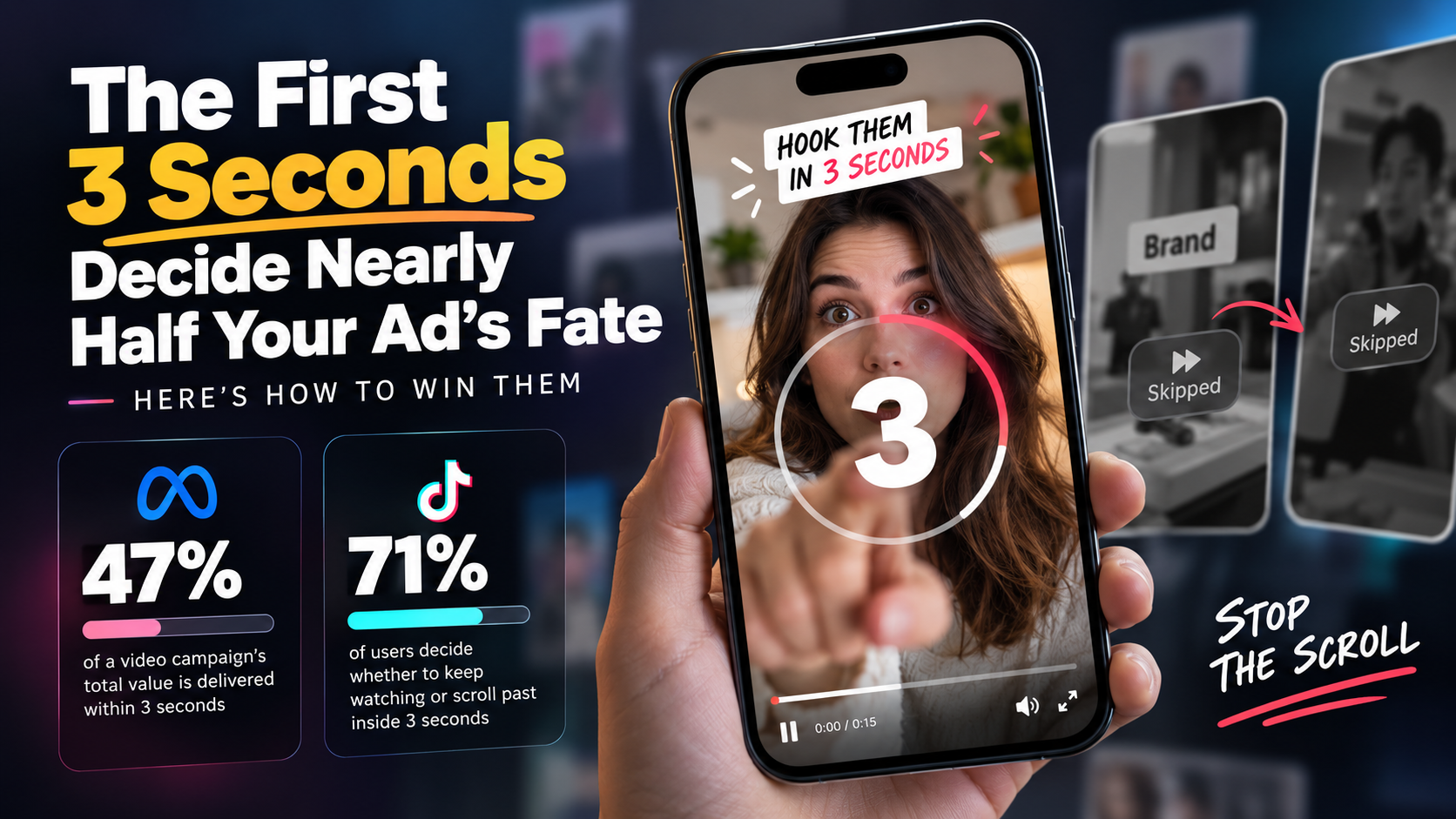
Meta’s own internal analysis has found that 47% of a video campaign’s total value is delivered within that opening three-second window. On TikTok, the number is even more extreme — 71% of users decide whether to keep watching or scroll past inside those same three seconds. Miss that window, and it doesn’t just mean one viewer scrolled away. It means the platform’s algorithm notices, and starts showing your ad to fewer people.
This is the single most measurable, most overlooked lever in video ad performance — and unlike most creative advice, it comes with an exact number you can check your own ads against.
What Hook Rate Actually Is
Hook rate is the percentage of people who keep watching past the first three seconds, calculated as:
(3-second views ÷ total impressions) × 100
If your ad was shown to 10,000 people and 3,000 of them watched past the three-second mark, your hook rate is 30%.
This is distinct from completion rate or overall watch time — it isolates one specific moment: did your opening visual, sound, or first line of copy actually stop someone from scrolling past. Everything else your ad does — the product demo, the offer, the call to action — only gets seen by the share of people your hook managed to keep.
The Benchmarks: How to Know If Your Hook Is Actually Working
Guessing whether your opener is strong is unnecessary — there are real, current benchmarks to check against:
On Meta, a hook rate of roughly 30% or higher is considered strong. Below that, most of your media budget is being spent on impressions that never really had a chance to convert.
On TikTok, the bar is higher — 40% or above is a solid hook rate, reflecting how much faster attention decisions happen on that platform.
Clips that hold 70–85% retention at the three-second mark earn roughly 2.2x more total views than weaker openers, because platforms actively reward early retention with broader distribution.
On the other end, anything under roughly 60% retention at three seconds tends to get throttled by the platform’s delivery algorithm — meaning a weak hook doesn’t just underperform, it actively limits how many people ever see the rest of your ad.
One important nuance: benchmarks vary by category, and it’s worth knowing where your industry naturally sits before judging your own numbers against a single universal target. Categories like apparel and pet products, for instance, tend to sit meaningfully below the cross-industry average even with genuinely good creative — often because the product itself doesn’t create instant visual novelty in frame one. If you’re in a category like that, benchmark against your own category average, not a generic cross-industry number.
Why This Matters Beyond Just That One Ad
The three-second window doesn’t only determine whether one viewer keeps watching — it determines how far the platform is willing to push your ad in the first place.
Both TikTok and Instagram use early retention as a distribution signal. When a video is first published, it’s shown to a small initial test audience. If that group watches past the first three seconds at a strong rate, the algorithm interprets this as a quality signal and expands distribution to a larger audience. If viewers scroll away immediately, the system slows or stops pushing the video further — regardless of how strong the rest of the content is.
In other words: a weak hook doesn’t just cost you views on one impression. It caps your organic and paid reach before the rest of your creative — the part you probably spent the most time and budget producing — ever gets a fair chance to perform.
How to Actually Build a Stronger Hook
Based on frame-by-frame analysis of consistently high-performing video ads across Meta, TikTok, and YouTube Shorts, a few patterns show up repeatedly in the openers that work:
Open on the payoff, not the setup. Ads that lead with a direct claim, a visual contradiction, or a bold statement in frame one consistently outperform ads that open with brand logos, slow context-setting, or a traditional “intro.” One frame-by-frame study found that 63% of successful TikTok ads convey their core message within the first three seconds — there’s no slow build-up.
Avoid opening in a way that visually reads as “an ad.” A notable share of ecommerce video ads — by some estimates as high as 73% — fail within the first three seconds specifically because the opening frame looks like traditional advertising rather than organic content. Native-feeling visuals outperform polished, obviously-branded openers in that critical window.
Test hooks in isolation before scaling the full creative. Because hook rate is measurable independently of the rest of the ad, it’s one of the few creative elements you can rapidly A/B test — swap only the first three seconds, keep the rest of the ad identical, and let the data tell you which opener earns the most attention before you commit media budget to the full version.
Get a face, product, or clear subject on screen immediately. Ads that delay showing the actual subject — a person, the product, a clear visual anchor — tend to underperform openers that put something concrete in frame from the very first moment.
The Bottom Line
Three seconds sounds too short to matter this much — but the data is consistent across every major platform: it’s not a minor detail, it’s close to half the outcome. The good news is that unlike broader creative strategy, this is a specific, measurable, testable variable. You don’t need to guess whether your hook is working. You can calculate your hook rate, compare it to a real benchmark for your platform and category, and know precisely whether your opening three seconds are earning the rest of your ad a fair chance — or quietly capping its reach before anyone sees the offer at all.